

Why Cement Residue Is So Difficult to Remove
Cement cargo is one of the most challenging materials to clean from industrial and maritime surfaces. Once exposed to moisture, cement hardens quickly and bonds strongly to steel structures.
In cargo holds, tanks, and confined spaces, this often leads to:
- Thick, hardened deposits
- Uneven surface coverage
- Strong adhesion to walls, stiffeners, and structural elements
In many cases, residue accumulates in corners, along weld seams, and behind structural reinforcements, making it particularly difficult to remove with standard cleaning approaches.
If not removed properly, cement residue can affect subsequent cargo, increase maintenance requirements, and lead to operational delays.
The Limitations of Traditional Cleaning Methods
Traditional cement cleaning relies heavily on manual labour combined with high-pressure water blasting.
This approach presents several challenges:
- Labour-intensive and physically demanding work
- Long cleaning times
- Inconsistent results depending on operator fatigue and access
- Safety risks from slippery surfaces and work at height
Vertical bulkheads and overhead structures are particularly difficult to clean effectively. In practice, operators often need to reposition equipment multiple times or rely on scaffolding to reach upper sections, which increases both setup time and operational risk.
How Robotic Cement Cleaning Works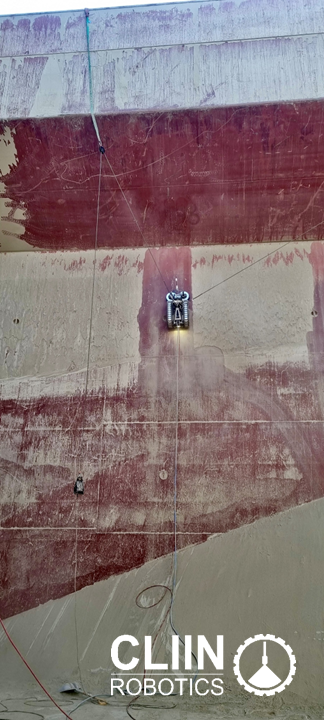
Robotic cleaning uses a crawler-based system equipped with a high-pressure cleaning tool to remove cement residue from steel surfaces.
In most operations, the operator remains inside the cargo hold or tank but stands safely on the floor with direct line-of-sight to the robot. The control unit is connected via cable, allowing precise control without the need to work at height.
Operators typically guide the crawler systematically across surfaces, working in sections to ensure full coverage of floors, bulkheads, and overhead areas.
The crawler uses magnetic adhesion to maintain contact with underlying steel structures. This enables stable movement across vertical walls and overhead areas, even when surfaces are coated or partially covered by hardened residue.
Key Advantages in Cement Cleaning Applications
Consistent Cleaning Performance
Robotic systems apply stable pressure and repeatable movement patterns, improving cleaning consistency across surfaces.
Reduced Physical Strain
The robot performs the heavy cleaning work, reducing operator fatigue and allowing longer effective working periods.
Improved Safety
Operators avoid working at height and remain on stable ground throughout the cleaning process.
Faster Turnaround
Continuous operation and improved access to difficult areas reduce overall cleaning time, particularly in larger holds.
Tackling Stubborn and Uneven Deposits
Cement residue is rarely uniform. Some areas may require more aggressive or repeated cleaning.
A robotic crawler allows operators to:
- Focus on heavily affected areas
- Maintain consistent pressure over time
- Revisit specific spots without fatigue
This is particularly useful along structural elements where cement tends to accumulate more heavily.
Designed for Real-World Conditions
Cement cleaning environments are harsh. Dust, moisture, and abrasive particles put significant stress on equipment.
Crawler-based robotic systems are designed to operate under these conditions, with:
- Robust construction
- Resistance to water and debris
- Stable adhesion on steel structures
This ensures reliable performance even in demanding cleaning scenarios, including environments where visibility and surface conditions vary.
A Practical Solution for Cement Cargo Operations
For operators dealing with cement cargo, robotic cleaning offers a safer, more efficient, and more consistent alternative to traditional methods.
By combining mechanical stability, strong adhesion, and operator-controlled precision, robotic systems are well suited to handle one of the toughest cleaning challenges in the industry.
To learn more about how robotic solutions are used in cargo hold environments, visit our Cargo Hold Cleaning page.
Interested in discussing your specific application or cleaning challenge?
Submit an inquiry through our website and our team will get back to you (here).